The oiled drawing-room door
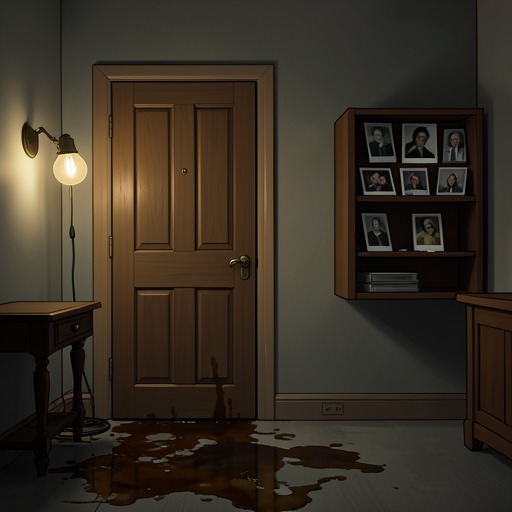
A Murder Is AnnouncedThe oiled drawing-room door is the second door Letitia Blacklock secretly prepared to move between the drawing room and hall without making a sound. It served first as part of the mechanics of her staged attack on Rudi Scherz, then as the material clue that helped expose the staging: what had been designed to disappear into the house became evidence against its designer.
Preparation and Concealment
Before the shooting, Letitia Blacklock had the door oiled so it could open and shut noiselessly. The preparation belonged to a broader sequence of covert arrangements: she had obtained Colonel Archie Easterbrook’s revolver, entered the otherwise empty house, and used the pretext of improving Phillipa Haymes’s flower arrangements to suggest moving a table outside the door. These seemingly domestic adjustments made the route and the room’s layout part of a plan that could pass as ordinary household activity.
The door’s concealment depended on its seeming unremarkable. During the staged hold-up, attention was drawn elsewhere: when the clock chimed at 6:30, those in the room looked toward it, while Letitia arranged for the lamp to short out. In the darkness and confusion, the oiled door allowed her to leave the place where she was expected to be and approach Scherz from behind.
Use in the Shooting
After the lights went out, Letitia slipped through the prepared door and came up behind Scherz as he swept the room with his flashlight. Wearing gardening gloves and carrying the revolver, she waited until his beam reached the wall near the spot where she was supposed to be standing. She fired twice, then, as he turned in surprise, held the revolver close to his body and fired again.
She left the revolver by Scherz’s body, tossed the gloves onto the hall table, and returned through the other door to her apparent position in the room. The oiled door thus enabled the crucial movement between the attack and the performance of being its intended victim. The arrangement helped make the shooting appear to fit the staged hold-up rather than reveal that Letitia had crossed the room to kill Scherz herself.
Discovery and Evidentiary Role
For a time, the door’s function remained hidden behind a convincing theory of what had happened. Inspector Craddock was dissatisfied with the apparent explanation, but until the door showed signs of tampering, the case had no physical evidence to support the reconstruction. He discovered the disturbance by catching hold of a handle by mistake; that accidental contact brought the concealed route into view.
The discovery changed the investigation. The door was not merely a convenient feature of the house but evidence that someone had deliberately prepared a silent passage and used it during the blackout. Craddock’s recognition that it had been tampered with gave the investigation a concrete basis and redirected the search toward someone with a motive to kill Letitia Blacklock. Its significance lies in that reversal: the very preparation intended to keep Letitia’s movement invisible left a trace that made the supposed explanation of the shooting untenable.